



¿Por qué algunas personas con diabetes se preocupan por el ejercicio?
Las personas con diabetes suelen preocuparse por hacer ejercicio debido al mayor riesgo de sufrir niveles bajos de glucosa (hipoglucemia) durante la actividad. Este es uno de los temores más comunes tanto para los jóvenes como para los adultos condiabetes1–5. Cuando los niveles de glucosa bajan demasiado durante o después de la actividad física, se puede sentir malestar.
De hecho, las personas que han sufrido episodios graves de hipoglucemia durante el ejercicio en el último año son más propensas a evitarel ejercicio1. La siguiente tabla muestra las barreras comunes a las que se enfrentan las personas con diabetes a la hora de hacer ejercicio, y las estrategias para ayudar a gestionarlas. ¡Queremos que las personas se sientan más seguras a la hora de controlar su diabetes y disfrutar de los beneficios del ejercicio regular!
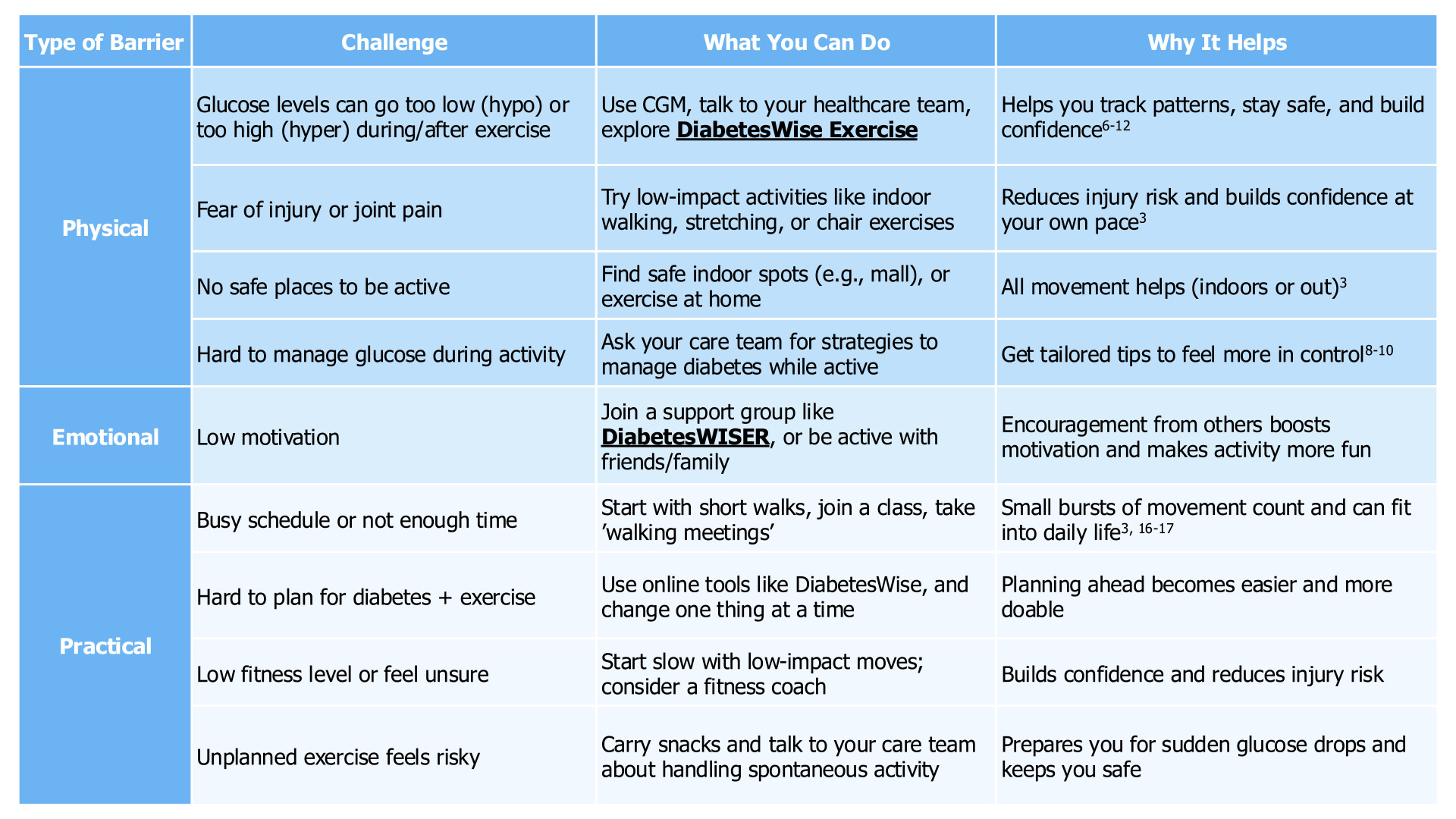
Las barreras más comunes para hacer ejercicio
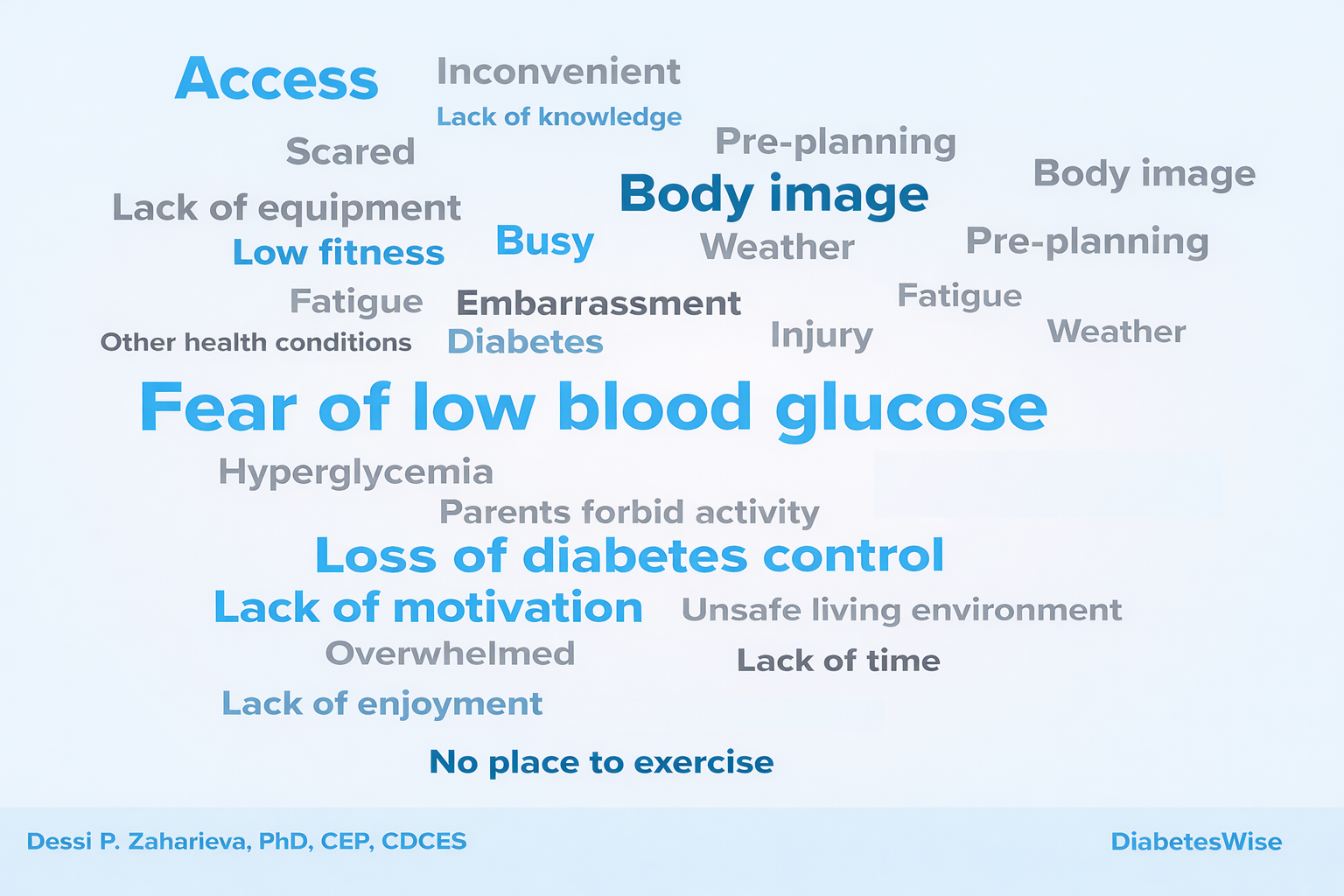
En la imagen siguiente, cuanto más grande es la palabra, más personas la mencionaron como un obstáculo para hacer ejercicio.1–4. Esta imagen ayuda a mostrar lo que más preocupa a las personas con diabetes a la hora de hacer ejercicio. Las experiencias de cada persona son diferentes, y todos los obstáculos son válidos5,6,11,17,19.
Physical Activity x Stigma Resources
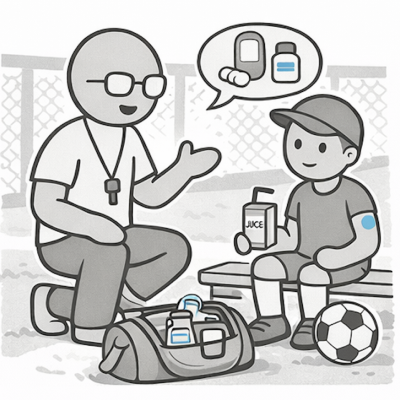
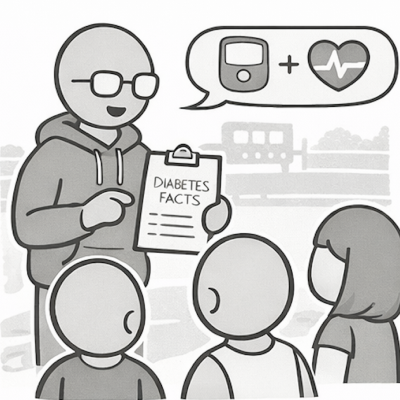
Diabetes management looks different for everyone. By learning the basics, addressing stigma, and working with athletes on a game plan, coaches can support both safety and performance during practices and competition.
Referencias
1. Brazeau AS, Rabasa-Lhoret R, Strychar I, Mircescu H. Barriers to physical activity among patients with type 1 diabetes. Diabetes Care. 2008;31(11):2108-2109. doi:10.2337/dc08-0720
2. Roberts AJ, Taplin CE, Isom S, et al. Association between fear of hypoglycemia and physical activity in youth with type 1 diabetes: The SEARCH for diabetes in youth study. Pediatr Diabetes. 2020;21(7):1277-1284. doi:10.1111/pedi.13092
3. Tripathi D, Vikram NK, Chaturvedi S, Bhatia N. Barriers and facilitators in dietary and physical activity management of type 2 diabetes: Perspective of healthcare providers and patients. Diabetes Metab Syndr. 2023;17(3):102741. doi:10.1016/j.dsx.2023.102741
4. Brazeau AS, Mircescu H, Desjardins K, et al. The Barriers to Physical Activity in Type 1 Diabetes (BAPAD-1) scale: predictive validity and reliability. Diabetes Metab. 2012;38(2):164-170. doi:10.1016/j.diabet.2011.10.005
5. Martin CG, Pomares ML, Muratore CM, et al. Level of physical activity and barriers to exercise in adults with type 2 diabetes. AIMS Public Health. 2021;8(2):229-239. doi:10.3934/publichealth.2021018
6. Glyn T, Fourlanos S, Paldus B, et al. The Need to Prioritize Education and Resources to Support Exercise in Type 1 Diabetes: Results of an Australian Survey of Adults With Type 1 Diabetes and Health Providers. Can J Diabetes. 2024;48(2):105-111.e5. doi:10.1016/j.jcjd.2023.11.003
7. Lascar N, Kennedy A, Hancock B, et al. Attitudes and barriers to exercise in adults with type 1 diabetes (T1DM) and how best to address them: a qualitative study. PLoS One. 2014;9(9):e108019. doi:10.1371/journal.pone.0108019
8. Logan JE, Prévost M, Brazeau AS, et al. The Impact of Gender on Physical Activity Preferences and Barriers in Adults With Type 1 Diabetes: A Qualitative Study. Can J Diabetes. 2024;48(6):401-408. doi:10.1016/j.jcjd.2024.05.003
9. Cockcroft EJ, Narendran P, Andrews RC. Exercise-induced hypoglycaemia in type 1 diabetes. Exp Physiol. 2020;105(4):590-599. doi:10.1113/EP088219
10. Get Active » DiabetesWise. Accessed July 22, 2025. https://diabeteswise.org/exercise
11. DiabetesWISER. DiabetesWISER. Accessed July 22, 2025. https://community.diabeteswise.org/
12. Livny R, Said W, Shilo S, et al. Identifying sources of support and barriers to physical activity in pediatric type 1 diabetes. Pediatr Diabetes. 2020;21(1):128-134. doi:10.1111/pedi.12938
13. Chinchilla P, Dovc K, Braune K, et al. Perceived Knowledge and Confidence for Providing Youth-Specific Type 1 Diabetes Exercise Recommendations amongst Pediatric Diabetes Healthcare Professionals: An International, Cross-Sectional, Online Survey. Pediatric Diabetes. 2023;2023(1):8462291. doi:10.1155/2023/8462291
14. Kime N, Pringle A, Zwolinsky S, Vishnubala D. How prepared are healthcare professionals for delivering physical activity guidance to those with diabetes? A formative evaluation. BMC Health Serv Res. 2020;20(1):8. doi:10.1186/s12913-019-4852-0
15. Zaharieva DP, Ritter V, Bishop FK, et al. Physical Activity Is Associated With Improved Glycemic Outcomes in Newly Diagnosed Youth With Type 1 Diabetes: 4T Exercise Program. Diabetes Care. Published online July 1, 2025:dc250765. doi:10.2337/dc25-0765
16. Michaud I, Henderson M, Legault L, Mathieu ME. Physical activity and sedentary behavior levels in children and adolescents with type 1 diabetes using insulin pump or injection therapy - The importance of parental activity profile. J Diabetes Complications. 2017;31(2):381-386. doi:10.1016/j.jdiacomp.2016.11.016
17. Kennedy A, Narendran P, Andrews RC, Daley A, Greenfield SM, EXTOD Group. Attitudes and barriers to exercise in adults with a recent diagnosis of type 1 diabetes: a qualitative study of participants in the Exercise for Type 1 Diabetes (EXTOD) study. BMJ Open. 2018;8(1):e017813. doi:10.1136/bmjopen-2017-017813
18. Paiement K, Frenette V, Wu Z, et al. Is Better Understanding of Management Strategies for Adults With Type 1 Diabetes Associated With a Lower Risk of Developing Hypoglycemia During and After Physical Activity? Can J Diabetes. 2022;46(5):526-534. doi:10.1016/j.jcjd.2022.02.009
19. Prévost MS, Rabasa-Lhoret R, Talbo MK, Yardley JE, Curry EG, Brazeau AS. Gender Differences in Strategies to Prevent Physical Activity-Related Hypoglycemia in Patients With Type 1 Diabetes: A BETTER Study. Diabetes Care. 2022;45(3):e51-e53. doi:10.2337/dc21-1899